This year I was back on the Patrouille des Glaciers, although rather than racing it as a competitor I was guiding two clients from Zermatt to Verbier.
We’d done some initial training and preparation with our original “A” team, but as the race got closer it became clear that one of the team members wasn’t quite ready. She was still recovering from an injury and, more importantly, was struggling with a distinct lack of energy.
We had a bit of a heart to heart and decided that the sensible option was to swap in our reserve skier.
This meant Olly got the call.
The only slight problem was that he hadn’t expected to race at all and had just a week’s notice.
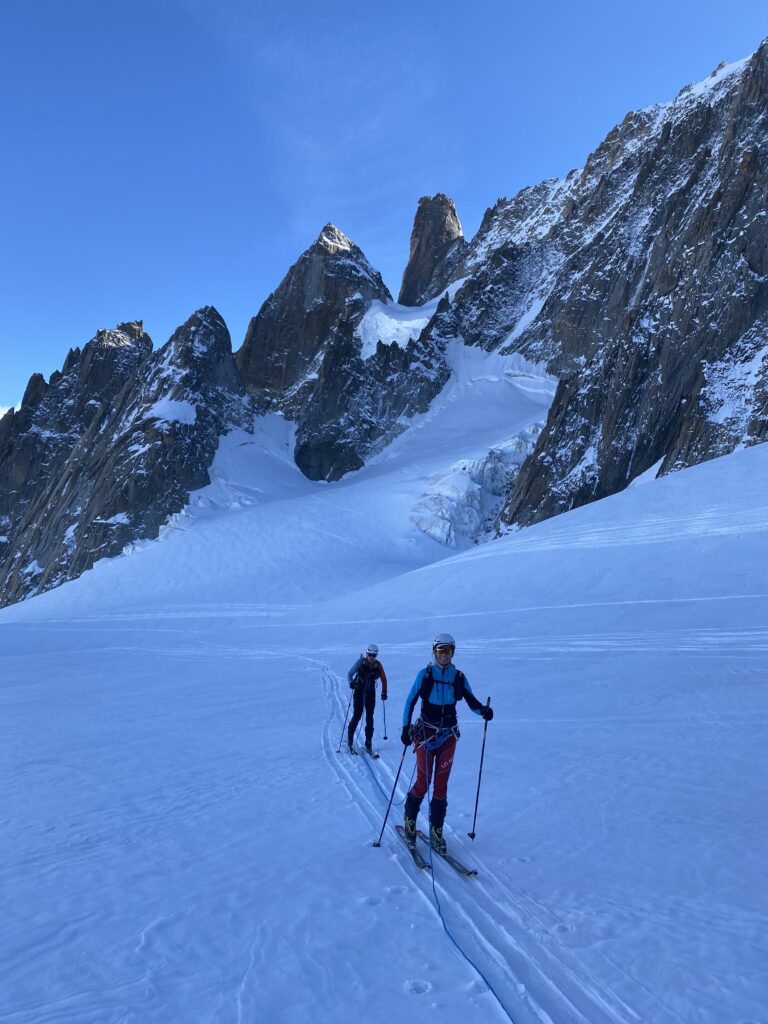
Skinning back to the Cosmiques refuge during our acclimatisation trip.
A quick change of plan
The PDG is a race where it is surprisingly easy to get timed out. The Arolla checkpoint is the main one to worry about, coming roughly halfway through the full course, after the high point at Tête Blanche and during the middle of the night.
It is a real crux point.
Looking at the pace we’d managed during our training day, it was clear that our original team wasn’t going to have enough buffer to make the Arolla cut-off comfortably. So, although it wasn’t the plan we’d started with, swapping Olly in made sense.
We had a few days to get him prepared.
We headed up the Aiguille du Midi for some training and acclimatisation, with a night at the Cosmiques refuge. We skied and skinned around the Vallée Blanche during the afternoon and again the following morning, while also talking through tactics and what we’d need to do during the race.
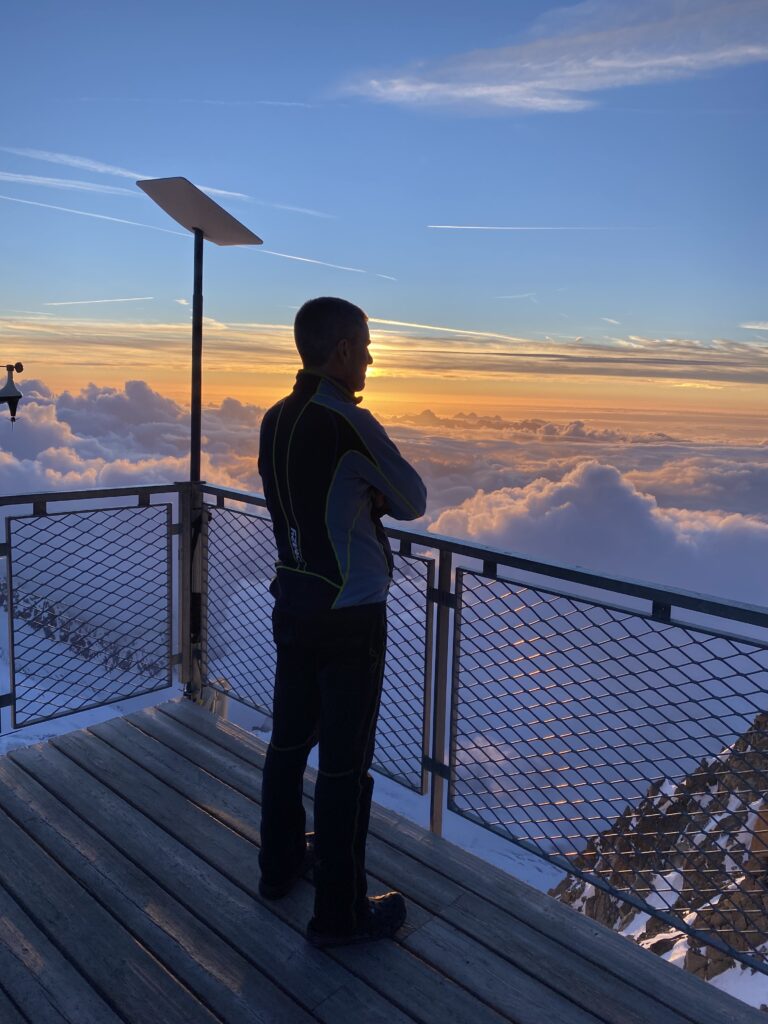
Taking in the view at the Cosmiques refuge after dinner.
That was about as much preparation as we were going to get.
The following morning we headed to Zermatt.
Zermatt
We left the car in Le Châble, below the finish in Verbier, and then used the train network and our free race tickets to get ourselves across to Zermatt.
Once there we completed registration and the equipment checks.
Olly also discovered that his ski helmet didn’t quite meet the required standard, so he had to go and buy an emergency replacement. Not quite the equipment purchase he’d been expecting a week before the race!
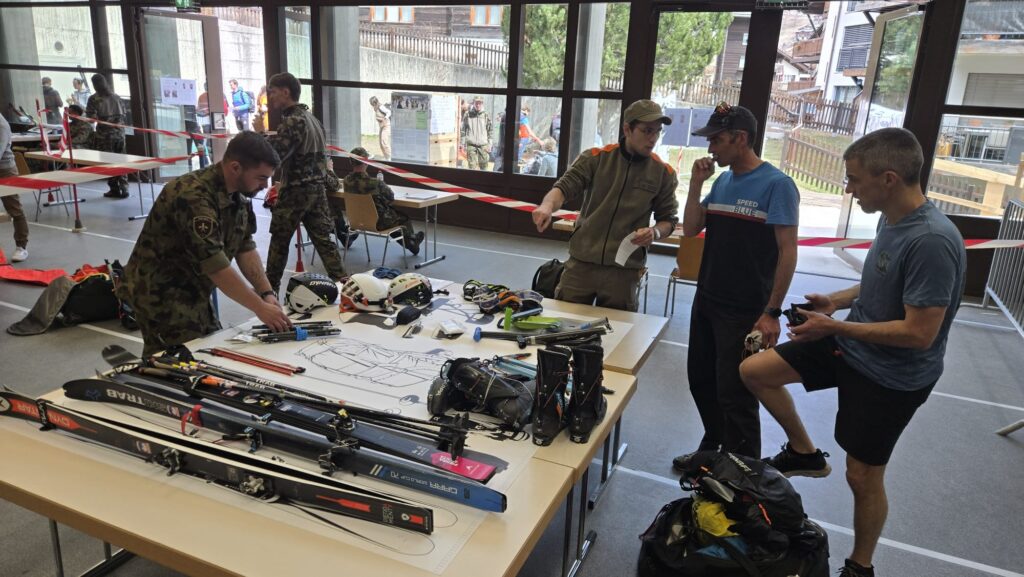
Equipment check in Zermatt. Everything is measured and stickers attached before the race.
We spent the night in the youth hostel, with enough time to get the kit sorted and eat the food they’d prepared for us.
Our start was at 00:30, which gave us some buffer for the cut-offs but not a huge amount.
We walked down to the start with plenty of time to spare, dropped our bags and went through the final equipment control. Headtorches were checked, spare gloves counted and avalanche transceivers tested.
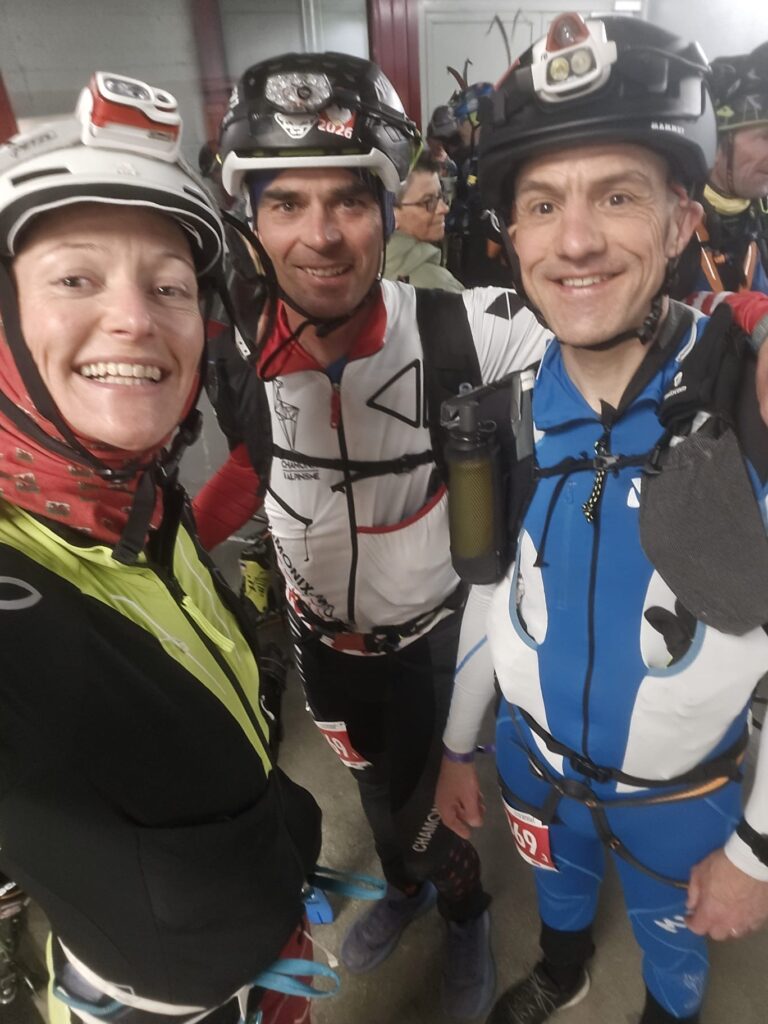
Team selfie before the start.
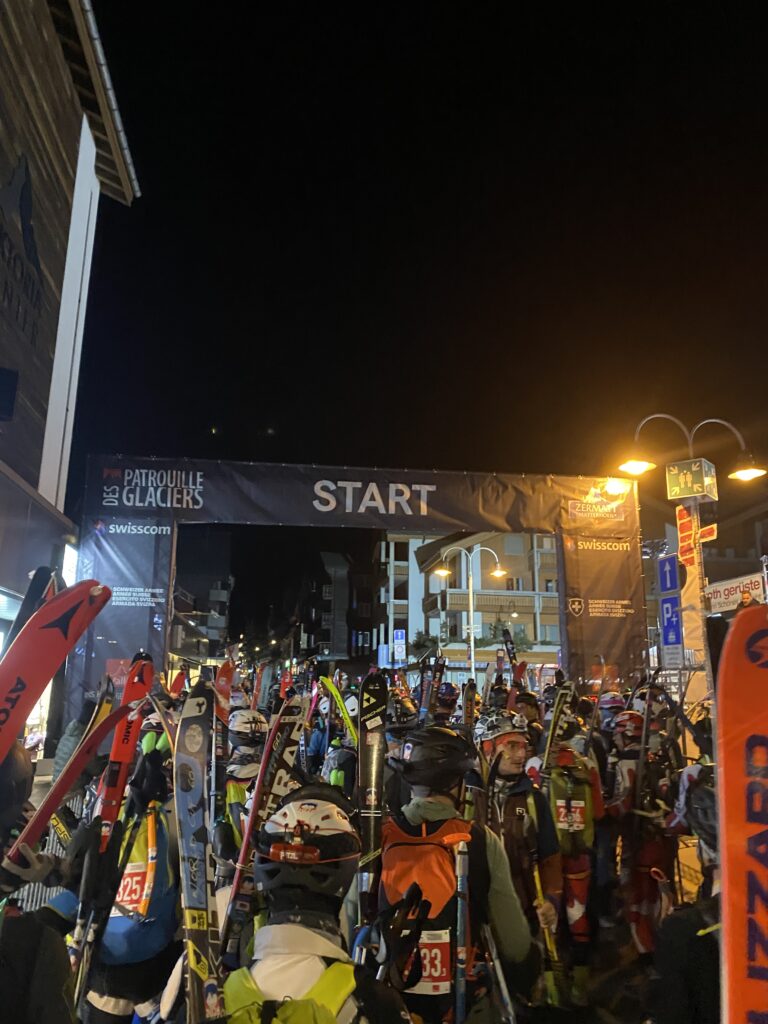
The PDG goes off in several wave starts, with your predicted finishing time dictating the starting slot. Faster teams last.
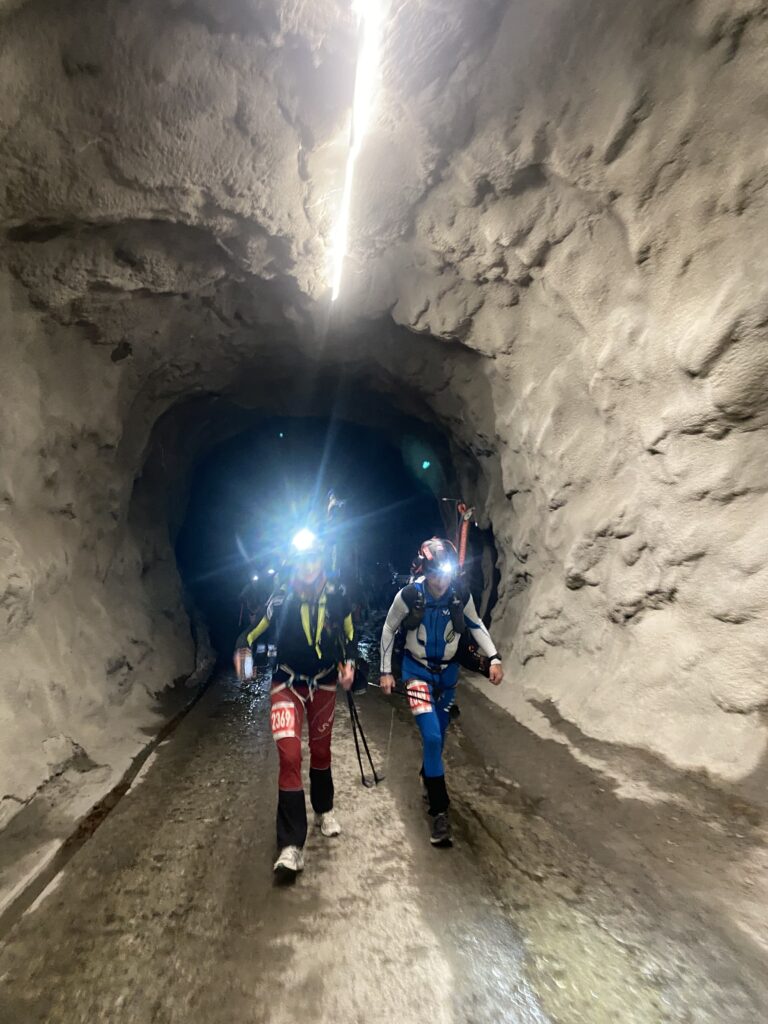
Up through a tunnel on our initial hike / run to the snow line.
Then we were ready.
The race start is always a fun experience, with the music and build-up before everyone heads off into the night.
This year we started in running shoes.
There is around 8km and 700m of climbing before you reach the snowline, so the first part is running and walking rather than skiing. Once we reached the checkpoint we could finally put our ski boots and skis on and abandon the trainers, which I believe are collected and given to charity.
Up to Tête Blanche
The first bit of skinning was fairly awkward.
It was icy and technical, with sections where we were skiing around the boulders on the lower glacier. We could see the headtorches of teams from the earlier starts above us, gradually making their way up the valley.
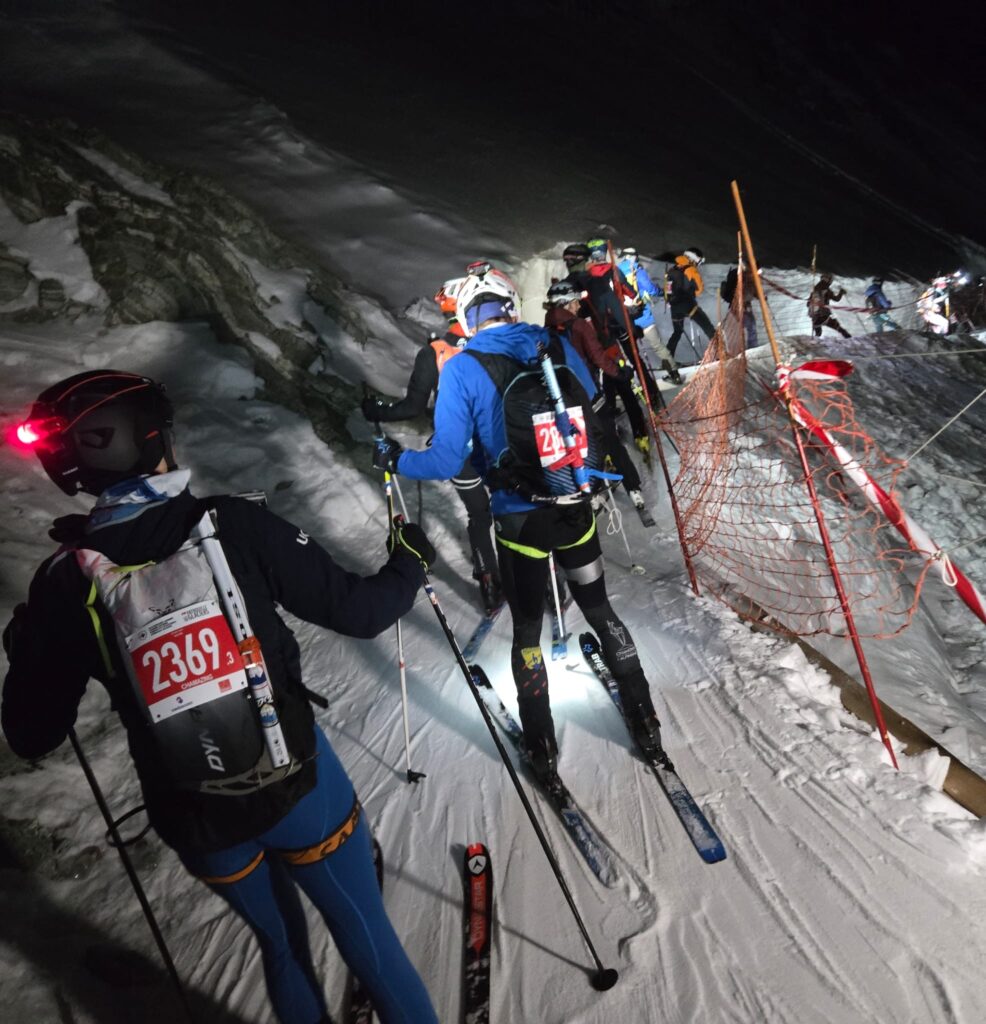
A bottle neck and some queuing during the night.
We slowly caught and passed them.
At some point we were directed to put the rope on, and from then onwards things became a little more complicated. Passing teams is never particularly easy when everyone is roped together, especially on corners, and there were a few moments where it became fairly chaotic.
The skinning was icy and quite technical, and a little fresh snow would have made life considerably easier.
There were a couple of boot packs too, including the infamous “wall”. It wasn’t particularly difficult as there was a very well-trodden and secure track, but it went on for quite a while.

Skiers heading towards Tete Blanche during the 2026 PDG.
By this point we’d put our warm layers on and swapped to bigger gloves. It was cold and there was a bit of wind despite the fact that we were climbing fairly quickly.
Eventually we reached the Tête Blanche checkpoint.
We’d covered 18.5km, climbed about 2,100m and had been racing for 4 hours 22 minutes.
For the first time in the race we took the skins off.
The descent to Arolla
Olly led the roped up descent, Catrin was in the middle and I was at the back shouting directions!
There was some fairly tricky skiing to start with, but once the terrain flattened out we could point the skis straight and keep some speed up across the flatter sections.
We made really good progress here and it felt pretty slick.
After the short climb to the Col Bertol we took the rope off. We wouldn’t need it again for the rest of the race.
Then came the long descent to Arolla.
It is quite a long ski and there is some difficult terrain, with lots of other skiers around and still complete darkness.
Olly’s lack of ski legs was starting to show by this point and the descent became a bit of a battle, including a couple of spills. We weren’t going to gain anything by rushing it, so we took our time and concentrated on getting down in one piece.
Arolla was absolutely teeming with people.
There were spectators, checkpoint staff and racers everywhere.
We had more than 30 minutes of buffer at this point, but Olly had already made the decision to call it a day. He’d done a fantastic job stepping in at the last minute, but the chances of an injury-inducing crash were increasing and there was still a long way to go.
It was the sensible decision.
Mark, who had come out as our support crew, was at Arolla with food and moral support and was able to give Olly a lift back towards Chamonix.
So suddenly it was just Catrin and me for the second half of the race.
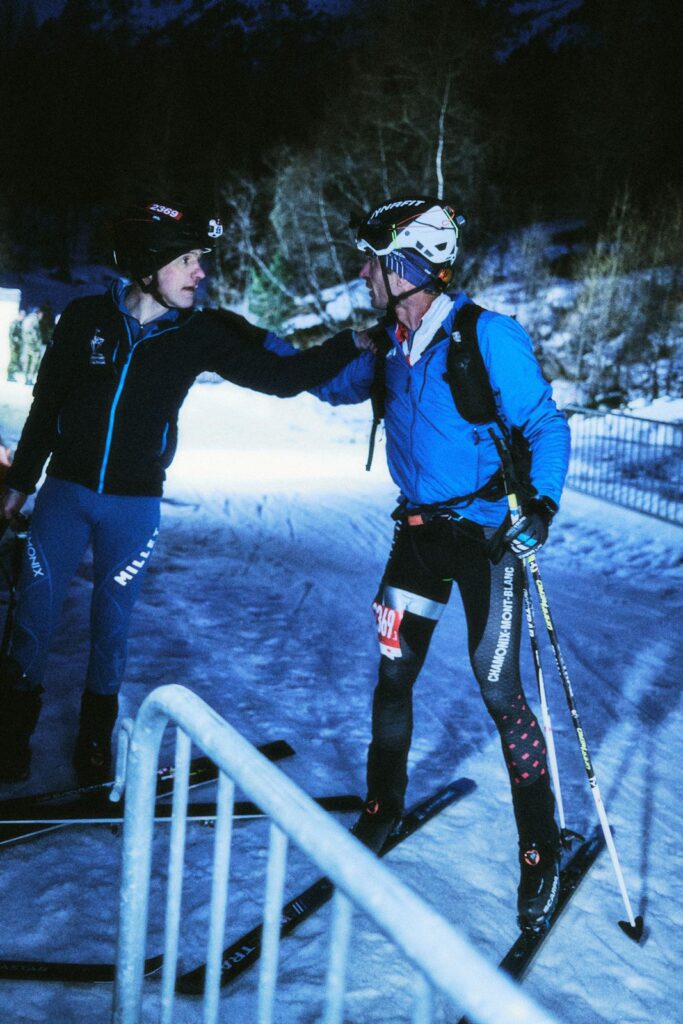
The Arolla check point and saying goodbye to Olly.
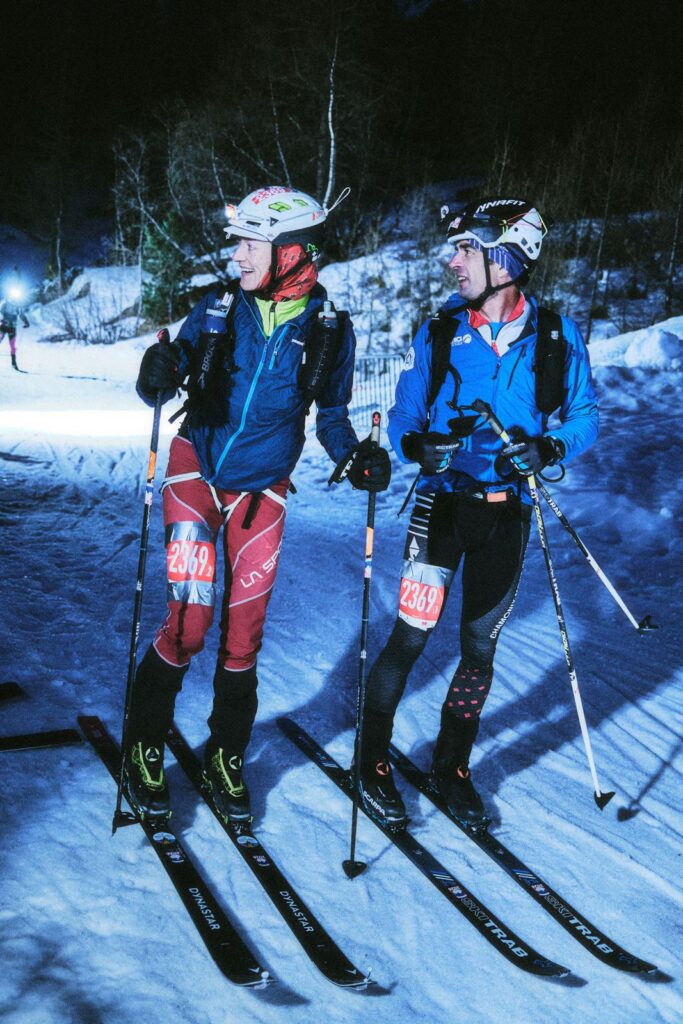
Catrin and I about to set off on the second half of the PDG.
Out of Arolla
The skin out of Arolla starts directly up the piste and is usually pretty icy first thing in the morning.
Dawn was just breaking as we started climbing.
We stopped halfway to change skins and then it was just a good grind up the piste before joining the purpose-built track towards the Col de Reidmatten.
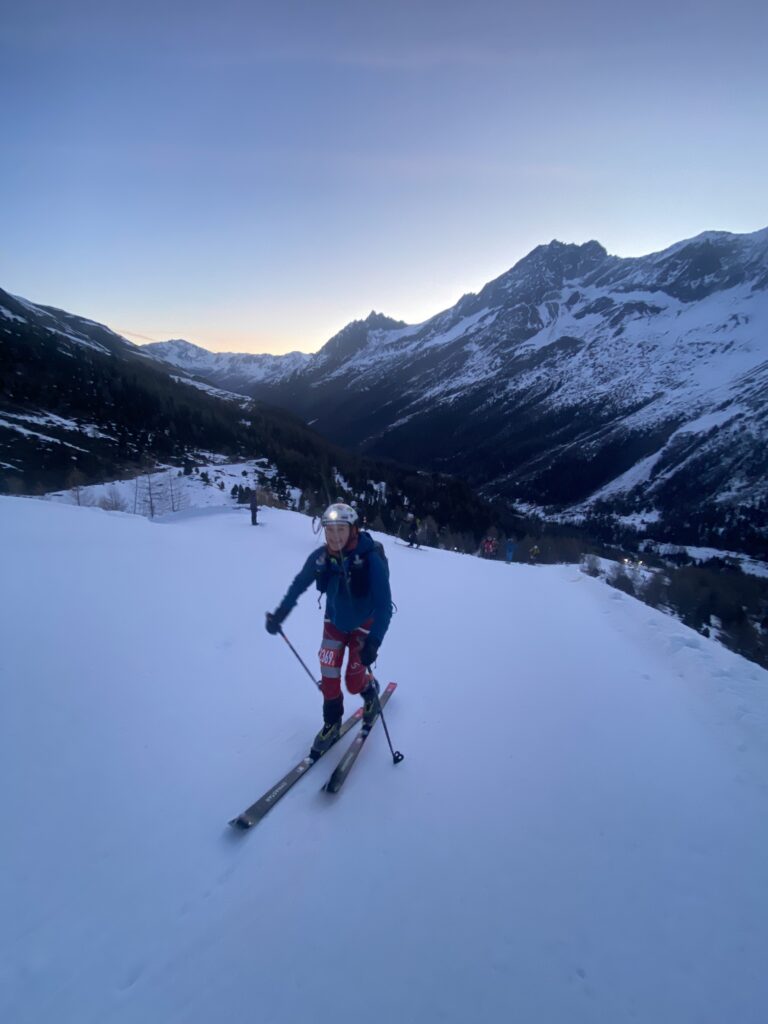
Catrin skinning on the icy piste out of Arolla.
By this stage some of the elite teams, who had started three hours after us, were beginning to catch us. It was pretty impressive to see them coming through and to watch the battle for the front of the race from relatively close up.
Further along, the traverse around Lac des Dix was an interesting mixture of skinning and poling/skating.
Skins were easier but slow. Skating took considerably more energy, but was probably four times as fast.
Catrin was going well and we skated nearly the whole way, making up plenty of time.
We skipped the aid station at La Barma and carried on towards Rosablanche.
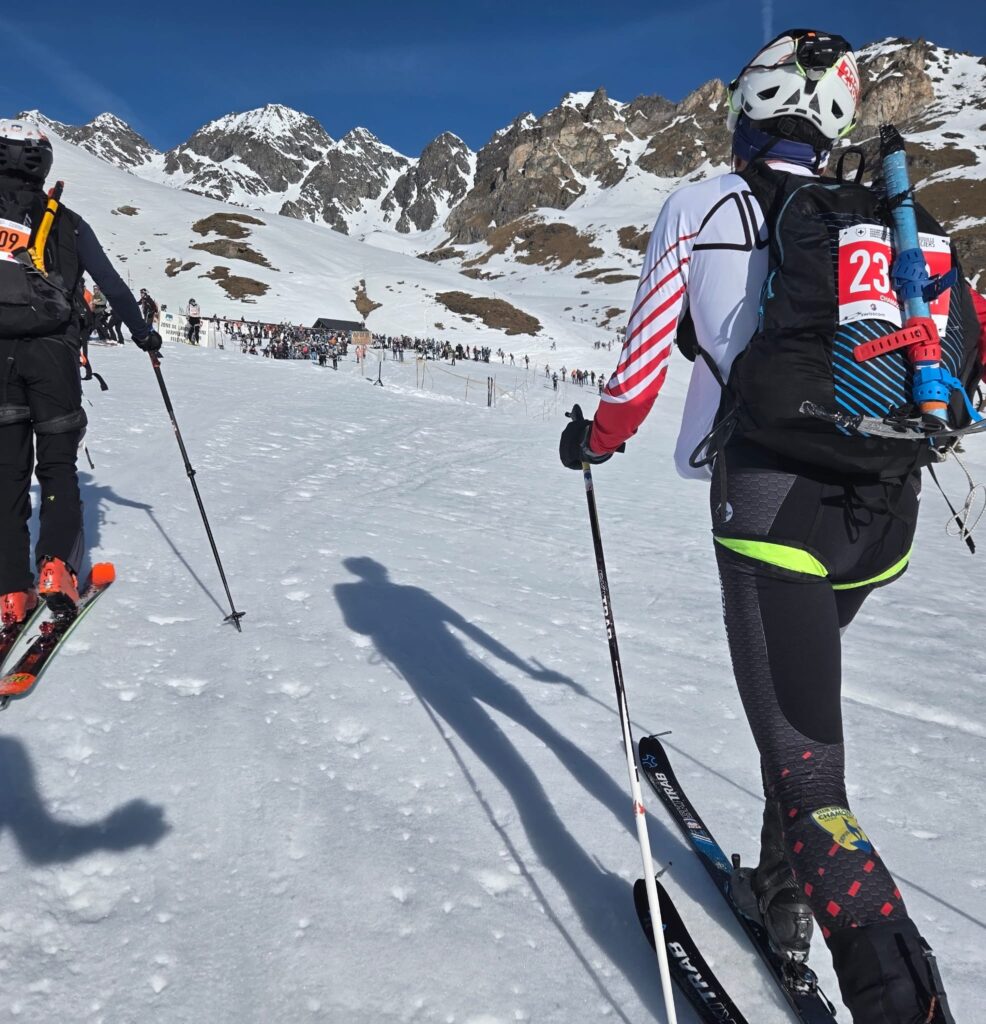
Hot skinning after the lac des Dix
The final climb
The climb towards Rosablanche was pretty hot in the direct sun.
Glacier glasses and sun hats came out and we settled into the long slog upwards.
There was still plenty of technical skinning, particularly when overtaking teams who were occupying the good tracks. We were now also passing people doing the shorter Arolla–Verbier race, so things were getting pretty busy.
The atmosphere was excellent though.
There were plenty of spectators around the cols, many of whom had skied over from Verbier, and it gave everyone a good boost.
We were still in race mode, making quick transitions and skiing the descents fairly quickly in formation.
You can make quite a lot of time on the PDG simply by choosing a good line and skiing it efficiently. Catrin was skiing well and it was probably some of the best guiding I’d done all season.
Verbier
The final run into Verbier was great.
We were carrying our skis and there were lots of people lining the route and cheering. Catrin’s supporters had come out as well, which made the final few minutes even better.
By this point we were pretty dehydrated and tired, but very pleased with how things had gone.
We finished in just under 11 hours, which is a pretty impressive time for the full Zermatt–Verbier course.
Congratulations to Catrin on an excellent race, and a massive thanks to Olly for stepping in at the last minute and getting us safely to Arolla.
We made full use of the post-race facilities, got changed into civilian clothes, ate some food and collected our race swag.
What a journey.
I left Catrin to stay in Verbier with her friends and headed back to Chamonix for a proper shower, some more food and an early night.
All in all, a pretty good day at work.
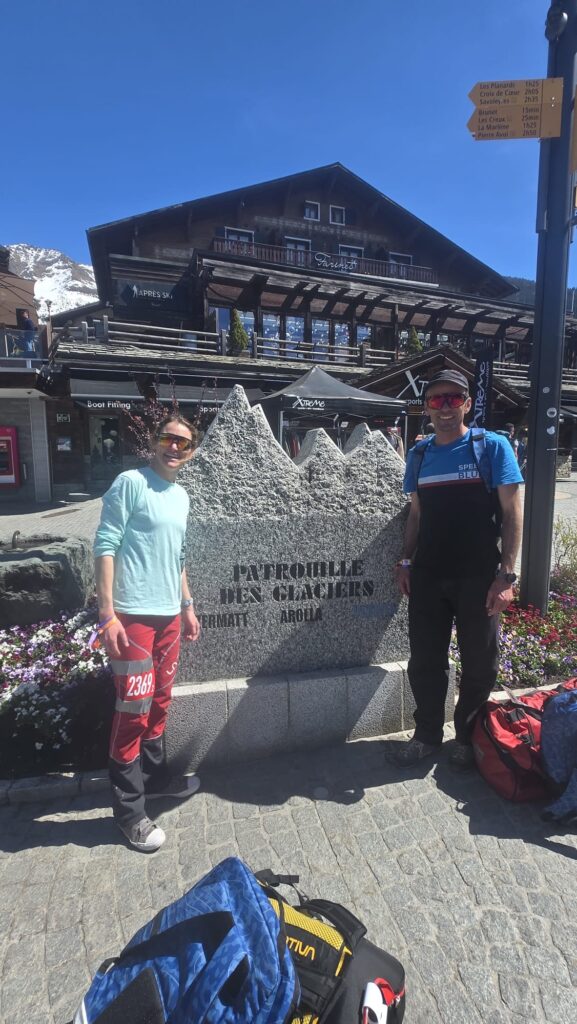
What an epic event, and a big day out in the mountains. Thanks to Catrin for instigating the whole idea, Anouk for bravely stepping aside (a tough decision that one) and Olly for being game for a last minute total beasting!


 Last-Minute Bookings & Custom Dates